The Rise and Decline of the Redneck Riviera by Harvey H. Jackson
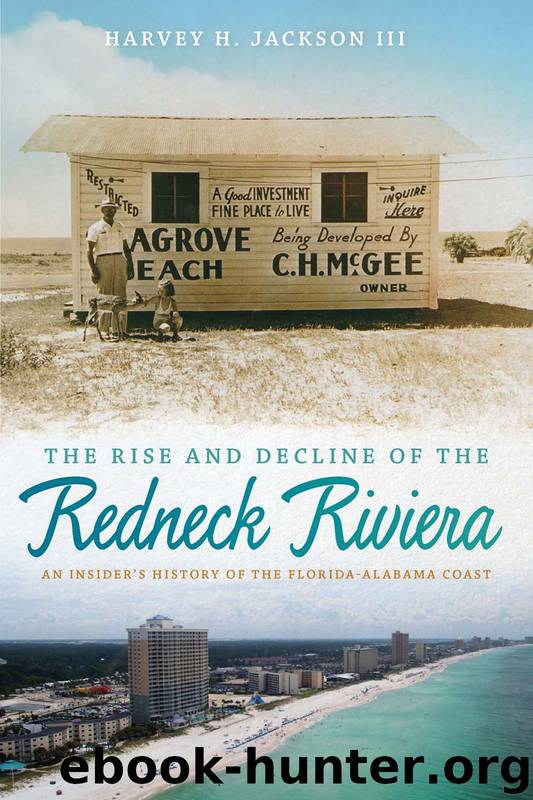
Author:Harvey H. Jackson
Language: eng
Format: mobi, epub
Publisher: University of Georgia Press
Published: 2012-01-18T05:00:00+00:00
ELEVEN
Taming the Redneck Riviera
SHORTLY AFTER THE 1978 Howell Raines New York Times article gave the Redneck Riviera national exposure, concerns that the nickname might bring negative publicity to the region prompted a member of the Gulf Shores City Council to introduce a resolution condemning the label. It was voted down. Mayor Mixon Jones, one of the three real estate developers who served on the council and an opponent of the measure, explained his vote this way: “No, sir,” he told a writer from Sports Illustrated, “we don’t think the publicity [from the Raines article] was all that bad. . . . We believe that any publicity helps—good or bad—just so they spell our name right.”
That may have been the prevailing attitude then, but in the years that followed, as chambers of commerce and tourist development councils sought to attract more upscale, affluent visitors, boosters tried to distance their beaches from the name and the image it conjured up. For the most part they succeeded, and by the turn of the century a travel writer for the Montgomery Advertiser passed over the “fortunately short-lived sobriquet ‘Redneck Riviera’” with little comment, while Golf & Travel announced that down in south Baldwin County the “Redneck Riviera [is] no more.” As if to confirm this transformation, in 2002 Panama City Beach tourist promoters came up with a new slogan—“White Sand, White Wine, White Necks.”
In their efforts to put the region’s redneck past behind them, advocates of the upscale had little interest in preserving what was left of the old. Besides, forgetting the past and embracing the future had always been what the coast was about. In the fall of 2000, the Panama City newspaper noted, “With only minute amounts of undeveloped beachfront property left . . . a new trend is afoot to demolish small, decades-old properties and build taller and much denser buildings in their place.” The old Gulf Crest Motel, whose “Holiday Inn rip-off neon sign” was a landmark on Panama City Beach not unlike the Green Knight in Destin, was one of the first to go. In its place they built what was the tallest building on the beach, for a little while at least.
Even the older residential communities showed little enthusiasm for clinging to what used to be. In the early 1990s Robert Davis and Van Ness Butler were, according to Davis, “almost tarred and feathered” when they “made a proposal for a historic district” in Grayton Beach that included a plan for managing “the conservation and development” of the village. Davis and Butler backed off, and in the years that followed, Grayton’s dirt streets were paved, “monster houses” were built in and among the older cottages, and more restaurants and shops opened, including one with grounds designed to replicate, or at least resemble, Monet’s garden at Giverny—a far cry from Ross Allen’s Jungle Show, which once packed them in at Panama City Beach.
But modern tourists did not come to the beach to savor the old. Back in the 1990s
Download
The Rise and Decline of the Redneck Riviera by Harvey H. Jackson.epub
This site does not store any files on its server. We only index and link to content provided by other sites. Please contact the content providers to delete copyright contents if any and email us, we'll remove relevant links or contents immediately.
| Africa | Americas |
| Arctic & Antarctica | Asia |
| Australia & Oceania | Europe |
| Middle East | Russia |
| United States | World |
| Ancient Civilizations | Military |
| Historical Study & Educational Resources |
Cat's cradle by Kurt Vonnegut(15447)
Pimp by Iceberg Slim(14689)
4 3 2 1: A Novel by Paul Auster(12524)
Underground: A Human History of the Worlds Beneath Our Feet by Will Hunt(12150)
The Radium Girls by Kate Moore(12097)
Wiseguy by Nicholas Pileggi(5845)
The Fire Next Time by James Baldwin(5509)
Perfect Rhythm by Jae(5475)
American History Stories, Volume III (Yesterday's Classics) by Pratt Mara L(5342)
Paper Towns by Green John(5253)
Pale Blue Dot by Carl Sagan(5084)
A Higher Loyalty: Truth, Lies, and Leadership by James Comey(5021)
The Doomsday Machine by Daniel Ellsberg(4559)
The Mayflower and the Pilgrims' New World by Nathaniel Philbrick(4546)
Killers of the Flower Moon: The Osage Murders and the Birth of the FBI by David Grann(4490)
The Sympathizer by Viet Thanh Nguyen(4450)
Too Much and Not the Mood by Durga Chew-Bose(4392)
The Borden Murders by Sarah Miller(4390)
Sticky Fingers by Joe Hagan(4258)
